Register or check your status
Sign up to vote, or see if you are already registered. It takes a few minutes online.
Most of what has happened so far happened without public input. However, none of these projects are a done deal. YOUR VOICE MATTERS! Below are the ways you can take action. (WORDING)
A comment on a permit application enters the official record, and the agency must consider it before acting. It is one of the most effective things most people can do, and it takes about twenty minutes.
Bedington Project: storm water construction permit, WVR113565. The application is under review. A public comment period is expected but has not been announced.
Bedington Owner LLC, a company connected to the Washington, DC developer Penzance, is asking the West Virginia Department of Environmental Protection (WVDEP)for permission to begin the first phase of a planned 637-acre data center campus in Bedington, designed for more than 600 megawatts. This first phase is rough grading: clearing and reshaping 430.93 acres of farmland and pasture, moving about one million cubic yards of earth, and digging a borrow pit on a separate parcel north of Hoke Run. Work is scheduled from November 2026 through April 2029. The permit covers how muddy and polluted runoff will be controlled during construction.
Grading on this scale carries risks to nearby water. Heavy storms can overwhelm sediment controls and send soil into Hoke Run and Opequon Creek, which flow to the Potomac. The site sits in a region of karst and limestone that can hide underground voids and where excavation and ponded water can open sinkholes that carry runoff directly into groundwater. Nearby homes rely on private wells, and mapped springs sit along Hoke Run.
It is important to note that the permiting process does not contemplate data centers energy demand, water withdrawal, noise, traffice, or ther impacts. The permit scope narrowly evaluates self-reported information and weighs it against established parameters. Each permit is considered only by the respective DEP division or federal agency independent of any other project component. In otherwords, as the WVDEP has acknowledged in pubic hearings for data center and microgrid projects around the state, permits are issued based on "technical demonstrations of compliance". 4
In Mason County, WV, for example, the stormwater construciton permit was approved after a WVDEP site inspection determined that the stormwater controls were in compliance with the approved plan. However, after a heavy rainstorm, runoff from the project site flooded an adjacent neighborhood and WVDEP issued 4 permit violations in next 18 days. After the site flooded again, a unilateral enforcement order was issued and development was partially halted until adequate stormwater controls were implemented.
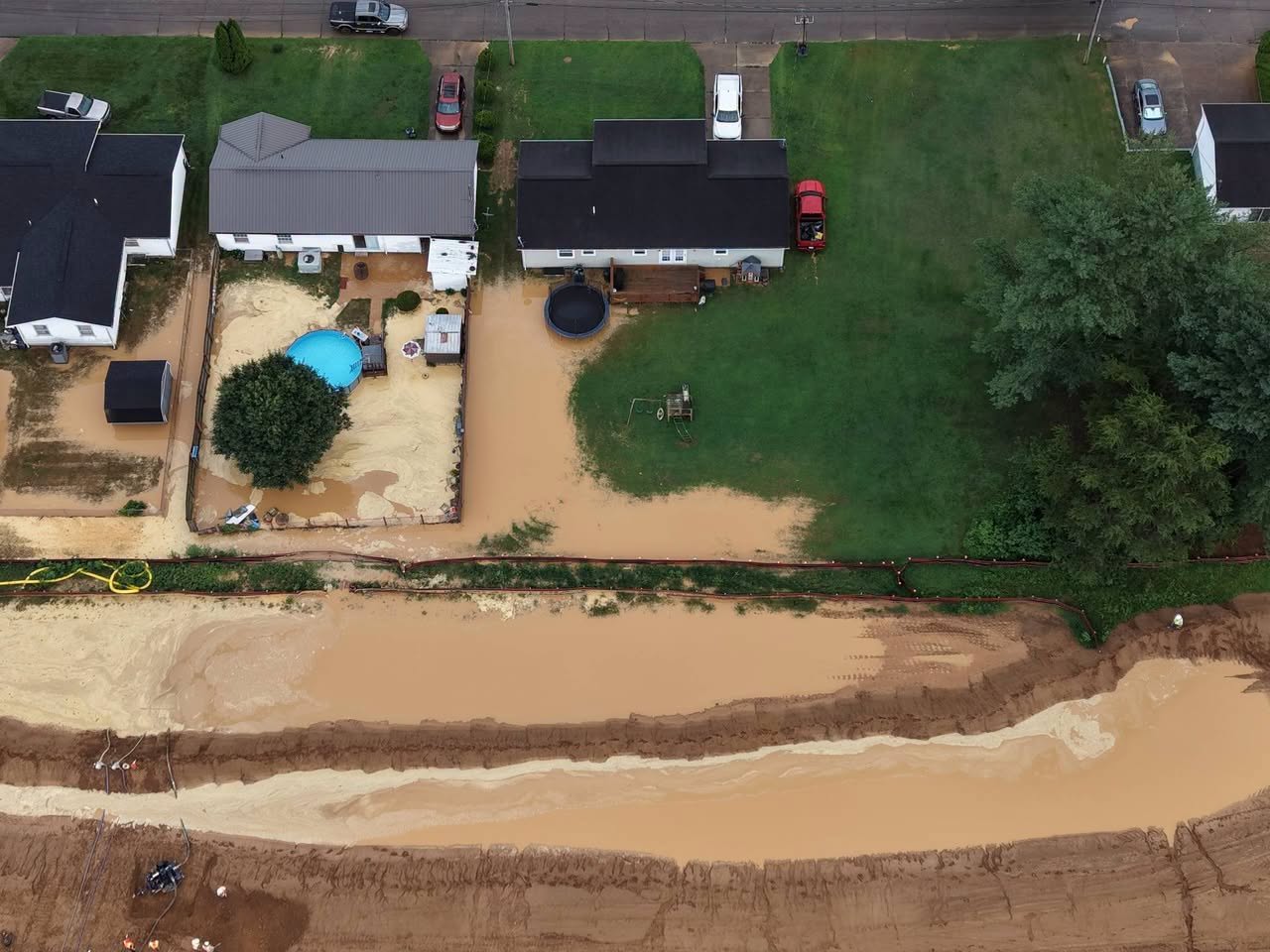
Just as the site for the Bedington Project partially lies in the 100-year flood plane of the Opequon Creek, the the site of the Monarch Compute Campus partially lies in the 100-year flood plane of the Ohio River.
For WV/NPDES permits, any interested person may submit written comments and may request a public hearing by writing to the Director of the Division of Water and Waste Management within 30 days of the public notice date. Comments received inside that window are considered before the agency acts on the application.
Your correspondence must include your name, address, and telephone number, along with a concise statement of the nature of the issues you are raising. Comments go to the email address printed in the public notice, or by mail to:
Director, Division of Water and Waste Management
West Virginia Department of Environmental Protection
ATTN: [permitting staff named in the notice], Permitting Section
601 57th Street SE
Charleston, WV 25304-2345
Stay inside what the permit controls. A storm water construction permit governs erosion, sediment, and what leaves the site during land disturbance. It does not govern water withdrawal, electricity, land use, or whether the facility should exist. An agency can only act on its own authority, so a comment about the wrong subject gets acknowledged and dismissed.
Then write it like this:
The voter registration deadline for the November 3, 2026 general election is Tuesday, October 13, 2026. That applies whether you register online, by mail, or in person. Mailed forms must be postmarked by that date.
| Date | What happens |
|---|---|
| October 13Deadline | Voter registration closes — online, by mail, and in person. Mailed forms must be postmarked by this date. |
| October 21–31 | Early in-person voting at the county courthouse, an annex, or a designated community voting location, during normal business hours. Open 9 a.m. to 5 p.m. on the last two Saturdays before the election. |
| October 28Deadline | Last day to apply for an absentee ballot. |
| November 2Deadline | Last day to hand-deliver an absentee ballot to your county clerk. |
| November 3 | Election Day. Polls open 6:30 a.m. to 7:30 p.m. You must vote at your assigned precinct. |
Source: West Virginia Secretary of State, GoVoteWV election calendar. Confirm dates and your polling location with your county clerk.
Placeholder
Register or check your status
Sign up to vote, or see if you are already registered. It takes a few minutes online.
Find your polling place
Look up the exact place you must vote on Election Day.
Berkeley County Clerk
Placeholder
400 West Stephen Street, Suite 103
Martinsburg, WV 25401
Phone: 304-264-1927 ·
Fax: 304-267-1794
[email protected]
Jefferson County Clerk
Placeholder Open 9:00 a.m.–5:00 p.m.
Jefferson County Government Complex
393 North Lawrence Street, Charles Town, WV 25414
Phone: 304-728-3215
[email protected]
The map below shows the West Virginia state senate and house of delegates districts. Find the district that your home is in, and you will know who represents you.
No district selected yet. Click or tap a district on the map.
Your district
District boundaries from the West Virginia Secretary of State (2022 redistricting). The map uses data from OpenStreetMap.
Staff count contacts by issue and by position. Volume matters, but so does being a constituent — an office logs a call from its own district differently from one outside it.
A phone call is logged individually. Mass emails are frequently batched and counted once. A call takes ninety seconds and follows a simple shape:
You will usually reach a staffer or voicemail. That is normal and it still counts.
Not sure who represents you? This tool uses your location to find your state senator and your house delegate. (There is also a district map above this section where you can tap your district to see its number.)
Find your state representatives
Enter your address or let the tool use your location, and it will list the senator and delegate who represent you, with ways to reach each office.
Berkeley County Commission
The board that makes decisions for Berkeley County. View the members, how to contact them, and the meeting schedule.
Jefferson County Commission
The board that makes decisions for Jefferson County. View the members, how to contact them, and the meeting schedule.
[Berkeley County Council and Jefferson County Commission — members, contact details, and meeting schedule. Say plainly what counties can and cannot do under HB 2014, and link to Law and Process, so people direct their asks somewhere they can land. -- Also include the upcoming county commussion hearing on the Berkeley County Comprehensive Plan that designates the Bedington site as conserve/sustain]
[Governor's office, WVDEP, and the federal delegation, with what each is responsible for.]
[A short skeleton. Same principle as permit comments: your own words, your own property, your own experience. Identical letters get counted once.]
HB 2014 changed the landscape of data center and commercial facility siting in West Virginia. Among other things, it barred local municipalities from having any say in the zoning, regulations, and local permitting of those facilities.
Every Saturday, 10 a.m. to noon.
Bedington Crossroads gas station, [full street address], Bedington, WV
[Two or three sentences: what it is, who comes, and what actually happens. Say whether it is a standing-with-signs gathering, a conversation with passers-by, or both.]
[A line about how the group handles hostile passers-by, and what is expected of participants. Setting that expectation in writing protects everyone.]
[Keep this short and say only what your counsel is comfortable having in public.]
[One or two sentences. Announce filings when they happen; describe unfiled matters only in the most general terms.]
Note: Nothing on this page is legal advice. If you have a specific concern about your own property, talk to a lawyer.